


What should you do if you are bitten by an animal while travelling?
Well, getting bit is never fun. But depending on where in the world you are, the consequences of an animal bite can be quite different. In large parts of the world, rabies is a risk. From personal experience, I know it can be difficult to find information about what to if you get bit by a dog or other animal on travels. That is why I have made this guide on what you should do if you get bitten by an animal while travelling.
He was sitting there, white, fluffy and happy, in the middle of the street of Essaouira’s Medina. It was almost like he was smiling at all the people walking past. It was the last day of our one-week Morocco adventure and while we waited for our transfer to the airport, I let me guard down. Forgetting my mother’s rule: never pet dogs or cats while travelling. A rule I for most parts have followed on all my travels.
After all, the dog certainly wasn’t a stray, he was wearing a bright blue harness. I bent down to say hi just as his owner came out of the shop next door. The pup loved the attention and was just being cute and playful. Perhaps a bit too playful. Like my dog at home, he tried to bite around my hand as part of playing. And since I’m used to this behaviour from a much larger dog, I didn’t think twice about it.

In short: This is what you must do
- Clean the wound with soap and water for 15 minutes.
- Contact medical attention as soon as possible.
- Not pre-vaccinated: Get the first post-exposure treatment within 24 hours. Including 1st dose of rabipur vaccine and a dose of immunoglobulin.
- Pre-vaccinated: Get your post-exposure treatment as soon as possible, no later than 72 hours.
- Follow the routine as prescribed by your doctor.
- Do not hesitate to do it abroad.
- Check if you can get treated for free.
- Consider getting vaccinated before travelling.
Getting bit by a dog while travelling
It wasn’t before we had walked a bit further that I noticed a tiny streak of blood on the back of my hand. Apparently, this dog we had much sharper teeth than the one I got at home. In all his playfulness he had scratched through my skin…
I pulled up some sanitizer napkins from my bag and rinsed the almost invisible wound thoroughly before drenching it in liquid sanitizer. It wasn’t really a bite, and it wasn’t a stray dog, so surely it can’t be of any risk?
Those were the questions I asked myself in the car enroute Marrakech airport a couple of hours later. Thinking of a young Norwegian woman who painfully died of rabies after playing with some innocent pups in Sri Lanka, I ended up calling my insurance company’s medical line.
No need to contemplate any more. Since the dog’s tooth (and saliva) had been in contact with my blood stream and Morocco is a high-risk country for rabies, the message was clear. Get vaccinated!
What is rabies?
Rabies is a deadly viral disease that affects mammals, including humans. It is typically transmitted through the saliva of an infected animal, most commonly through bites. The virus attacks the central nervous system, leading to a range of distressing symptoms, including fever, hallucinations, paralysis, and ultimately death. It can take months before clinical symptoms appear, and once they do, rabies is almost always fatal. This is why rabies is a serious concern for travelers, as encounters with potentially infected animals can occur in various parts of the world. In areas where rabies is prevalent, understanding how to respond to animal bites and seeking immediate medical attention is vital to prevent the virus from progressing.
A rabiate animal is often pictured as aggressive and mad, but bear in mind that it can take time for symptoms to show. An animal can be carrying and transmitting the infection even if they seem healthy.

Read more about rabies on World Health Organization’s website here. Here, you can see WHO’s map of the presence of dog-rabies from 2021. This map gives an image of the risk of rabies in different countries. Just do not trust it 100%. Even though it doesn’t look like any cases were reported in Europe in 2021, it may still be present. According to Norwegian health authorities (FHI), approx. 2000 cases of rabies amongst wild animals and 3000 cases amongst pets and livestock are reported every year in Europe. It’s not a high risk area, but you should still seek medical attention – especially if bit by an aggressive dog.
Ps! Do you wish to meet baboons? Visit Murchison Falls National Park in Uganda!
Is there a travel vaccine for rabies?
Yes, it is the same prophylaxis as the post-exposure rabies treatment. You can get it at any place giving travel vaccinations. You will need 2 or 3 doses, with 7 days between each. As it takes at least 7 days for antibodies to turn up, you should get your shots at least a few weeks before departure.
The pre-exposure vaccine is recommended to everyone travelling to and staying in rural areas with limited access to health services and people who are planning to be in contact with animals in countries with high risk of rabies.
As with everything else regarding rabies treatment and vaccines, advice about booster doses varies a lot. Some sources say you won’t need a booster, while others say you should get one after 2 years. Others again say that you should check your antibody status after 2 years if you plan on staying in a risk zone or handle animals.
Rabies treatment after you have been bit by animal while travelling
Getting vaccinated was easier said than done. Not only because I was on my way to the airport for my evening flight to Oslo before continuing to Bergen and home to Voss the next morning. But because the advices I got varied a lot. While some sources said you can wait 72 hours, others said you need to take the first rabies shots within the first 24 hour after the bite.

Lucky for me, I knew what was correct. This happened to a fellow student when I studied abroad in India, and I remembered the routine she had to go through. And, before going to Uganda in 2022 I talked about this with a nurse at the travel vaccine centre. See
So, this is what you have to do if you get bitten by a dog or another animal while travelling:
Post-exposure rabies treatment when you are not pre-vaccinated:
First: make sure to clean the wound as soon as possible. Wash it with soap and water for 15 minutes or use hand sanitizer if you don’t have access to clean water.
As long as you are not pre-vaccinated with 2 shots of Rabipur, visit a doctor immediately or as soon as possible and get your first shots within 24 hours after you were bit. This means that if you find yourself in a rural area without medical facilities, you need to get to a larger town.
The vaccination routine is as follows:
- Day 0: Rabipur prophylaxis and 1 dose of immunoglobulin
- Day 3: Rabipur prophylaxis
- Day 7: Rabipur prophylaxis
- Day 14: Rabipur prophylaxis
- Day 30: Rabipur prophylaxis
The immunoglobulin is injected directly in or around the wound and is important to neutralize any rabies virus hiding in the tissue before your body starts producing antibodies from the Rabipur vaccine. According to the official health websites I have used for research, it takes approx. 7 days from the first vaccine shot till antibodies shows.
Day 30 is written in italics because advice from health pages varies. Some say that the last injection is only for people with immunosuppressed conditions, while other says all doses to everyone. I’m not immunosuppressed and was automatically subscribed all doses.
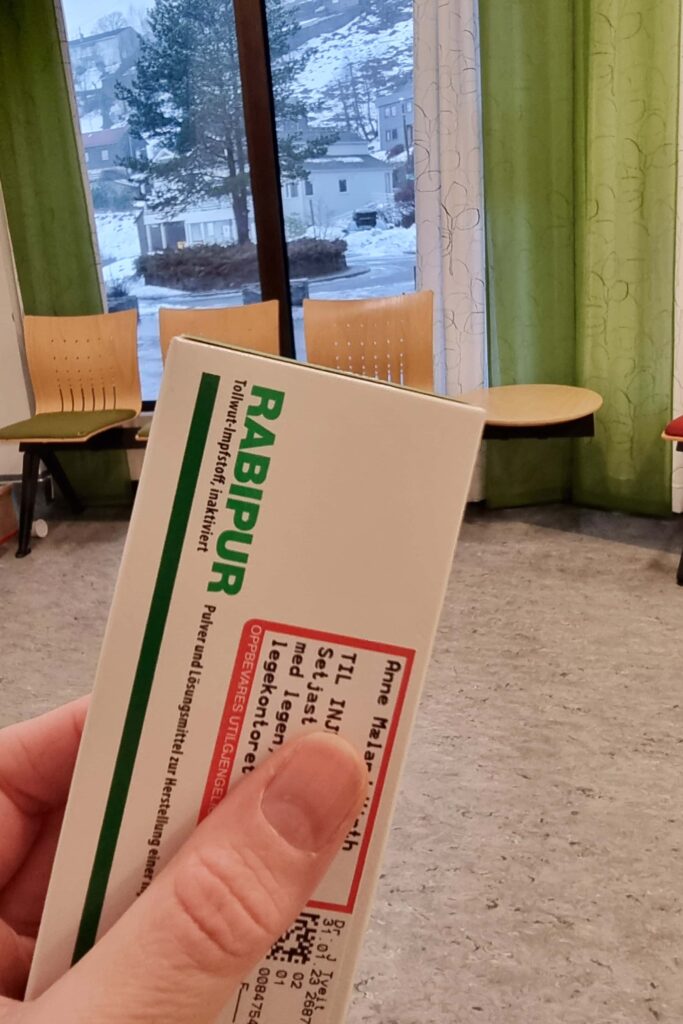

Rabies treatment if you are pre-vaccinated:
Cleaning the wound is just as important for you who are vaccinated before being bit. Wash with soap and water for 15 minutes or use hand sanitizer.
If you are pre-vaccinated with 2-3 doses, you already have a level of antibodies towards the rabies virus and only need 2-3 booster doses. You also don’t need the immunoglobulin injection.
While you should seek medical attention as soon as possible, you have a bit more time – which is why pre-vaccination is recommended for those travelling in rabies risk areas with lack of medical facilities.
If more than 2 years have passed since you were vaccinated, you can check your antibody status with a simple blood test.
- Day 0 – 3: Rabipur prophylaxis
- Day 3 – 7: Rabipur prophylaxis
- Day 14: Rabipur prophylaxis
- Day 30: Rabipur prophylaxis
As with the vaccination routine for those who are not pre-exposed, advice regarding the last doses varies. If you are immunosuppressed, you will need 3-4 doses.

Is the rabies vaccine injected into the wound?
Yes and no. The Rabipur vaccine is injected into your shoulder as with most vaccines. The immunoglobulin, on the other hand, must be injected into and around the bit wound to have any effect.
Unfortunately, the syringe was also one of the largest I have ever seen, and it was not a pleasant experience. But way better than getting ill by rabies!
Contraindications and side effects
What about children, pregnant women and people who have previously experienced allergic reactions to vaccines, can they skip the vaccination? Nope. Since rabies is a lethal virus that will kill you, there are no contraindications for this vaccine. If there is a risk of being infected, everyone needs to go through the vaccine routine. When symptoms appear, it is too late.
The only ones who should not get vaccinated are those who have had a severe allergic reaction to Rabipur or any of the ingredients in this vaccine.
As with most vaccines and medications, there are a chance of experiencing side effects. Personally, I didn’t feel anything (not even a sore arm), but that is individual. Most common are flu like symptoms, soreness at the injection site, headache and stomach issues.

How much does rabies treatment it cost?
This is a difficult question to answer, as prices of medical service differs from country to country.
Some countries consider rabies an infectious disease dangerous to the public and gives treatment free of charge. From my experience, I learnt that this was the case both in Morocco and in Norway. Check with the local health facilities, but do not let the price scare you off getting treated.
Always, always make sure to have a good travel insurance. If you need to pay for the treatment, your insurance should cover it. While I got my treatment for free, my insurance covered all extra costs including a huge taxi bill and the cost of the hotel room I should have stayed in instead of spending the night at an emergency room.
Pre-vaccination with 2-3 doses is like any other travel vaccines and you will have to pay for them.
Getting the vaccine abroad vs. at home
Well, this depends entirely on where you call home. But for me, home is Norway, which is one of the few countries in the world without any risk of rabies. I am 98% sure that the whole vaccination process had been easier if I had time to do it in Morocco. Just because they are more accustomed to it and have the vaccination available.
Also, since time is essential, what matters is getting to a medical facility as quick as you can after the accident.

I just about managed to get my first shots in time without missing my connecting flight to Bergen, but not before waiting a full night at the emergency room in Oslo.
Final thoughts after being bit by an animal while travelling
Do I wish I had gone through with the rabies vaccinations pre-travelling abroad? Maybe. It would have spared me of some stressful hours travelling back from Morocco, as I’d known I had more time. But given the seriousness of rabies and the fact that you still need to go through parts of the vaccination treatment, I had probably wished to get medical attention asap anyway.
At the same time, I now feel a bit more relaxed in front of upcoming travels, knowing that I have some antibodies against rabies.
Will I stop talking to animals on my travels? Definitely not. But I will continue to be careful petting them and for most parts stick to chatting with them. Rabies is not the only infection caused by animals…
One thing is certain: I must start photographing cute dogs on my travels! Looking through my photos, I got countless pictures of cats and none of dogs…


