


10 photos that will make you want to visit Dresden
To many, Dresden is known for being bombed to pieces by the Allied forces at the end of World War Two. But to others, the capital of Saxony in Germany is famous for its incredible baroque architecture. And it’s the combination of those two reasons that makes a visit to Dresden so interesting.
Looking through my photos in this article, can you believe most buildings were rebuilt after the war? We had a hard time wrapping our heads around that fact, even when looking straight at them!

This article is a visual journey that shows exactly how stunning Dresden is, highlighting some of the city’s must-see attractions plus a couple of hidden gems.
A quick introduction to Dresden
Dresden is the capital of the German state of Saxony, located just a short drive from the borders to Poland and the Czech Republic. It’s known as one of the most beautiful cities in Germany because of its outstanding baroque architecture set against the pretty landscape surrounding the river Elbe.
The historic centre dates back to the 18th century when Saxon was a state of its own. This is where you can find the Zwinger Palace, the Semperoper, Residenzschloss, the Frauenkirche and many more stunning buildings. In addition, Dresden has a well-known art collection and was once one of the cities that gathered art students from all around Europe.

Walking around the centre, it’s evident that Dresden and Saxon were wealthy back in the day. Why? Venture outside the city and you’ll see. In addition to the optimal location in the middle of Central Europe, the land is perfect for farming. There are grain fields as far as the eye can see.
Fast forward to 13 – 15 February 1945, when all of it could easily have been lost as the Allied forces dropped almost 4000 tons of bombs over the city, leaving it in pieces.
Luckily, it has been restored to its primer glory, and there’s no evidence that the buildings are less than 80 years old. The restoration of the Frauenkirche was completed as late as 2005.


My best tip for visiting Dresden
I visited Dresden with my dad and my boyfriend as part of a road trip in Germany and Poland in July 2024. As it was one of several destinations on this trip, we only planned 2 nights here. And because of car trouble in Bispingen, we missed our first afternoon and evening here.
This taken into account, I can’t call myself an expert on everything Dresden has to offer. But I have one very valid tip for you who plan to go here. Especially if you visit Dresden in summer.
Get up and explore early in the morning!
Like so many other beautiful cities around Europe, Dresden attracts plenty of visitors and it can get quite crowded during the day, let alone in the evenings when tourists and locals alike gather in the streets and the squares.
In the morning, it’s basically just you and some people on their way to the office. Two other good reasons for an early start are the soft morning light and to beat the heat. Because yes, Dresden can get quite warm in the summer. It was 30 degrees Celsius the days we were there, and the combination of it being an inland city made it almost a bit overwhelming to three Norwegians like us. Luckily, I had booked a fantastic apartment with AC in all rooms and a balcony with morning sun.
Click to see what Nuremberg looks like in the morning!
10 photos from Dresden and a bonus!
Okay, so I’ve already posted a few pictures but let’s get on with the chosen ones. Under each image you find a short text for context and my personal stories.
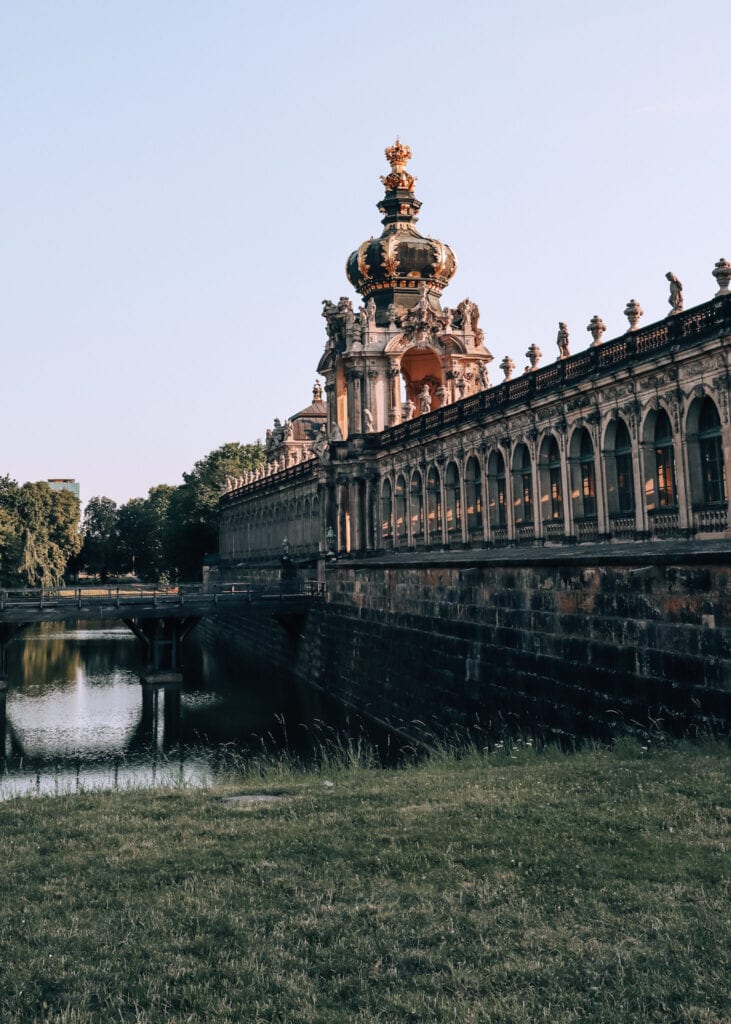
1. Morning glow of the Zwinger palace
Having arrived late in the evening after spending the day crossing our fingers outside a garage in Soltau, I was super-eager to get up early and explore the streets of Dresden. Following Google Maps, I made my way towards the Zwinger Palace. A Dresden must-see!
Accompanied only by some Dresdeners on their way to work, this was my first view of the impressive palace built in 1709. The early morning glow made the palace look even more stunning than later in the day!
The palace was built as a venue for tournaments and courtyard games for Dresden’s nobility, and although the courtyard itself was under reconstruction at the time of my visit, the main structure didn’t disappoint.
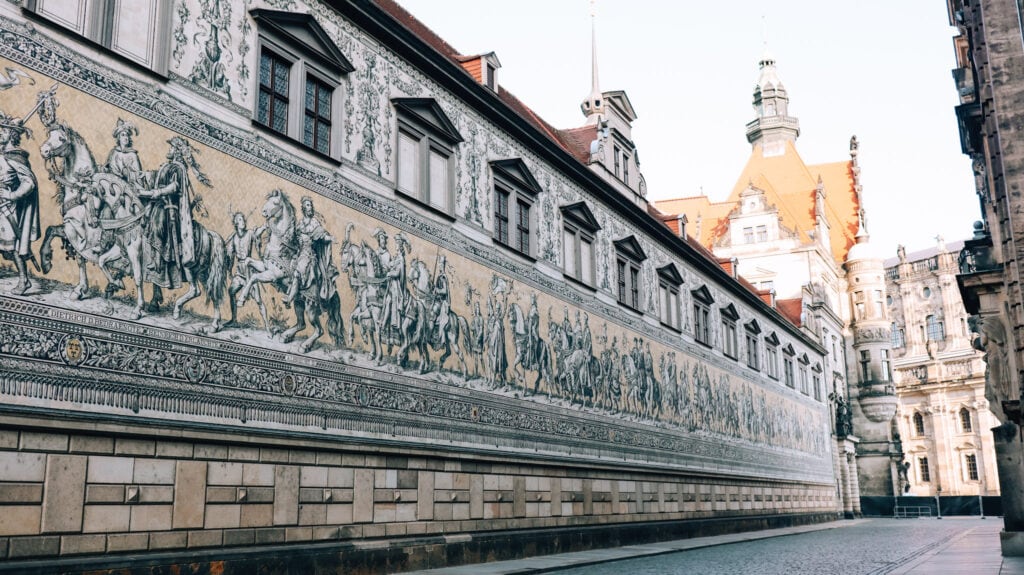
2. The Fürstenzug – 19th century street art
I love checking out interesting street art when I travel. Hence, the Fürstenzug was high up on my Dresden bucket list.
The Fürstenzug is a 102-metre-long mural on the outside wall of the stables at Dresden Castle. It pictures a procession of all the rulers of Saxon from the 12th century to the beginning of the 20th century. The wall was originally painted in the 1870’s but to be weatherproof it was replaced by thousands of porcelain tiles 30 years later.
It made it almost intact through the 1945 bombings, so what you see today is the original work from early 1900.
Come here early if you want to study (and photograph) it in peace and quiet. We actually found the whole street closed off due to security reasons most of the day as a politician was speaking nearby.
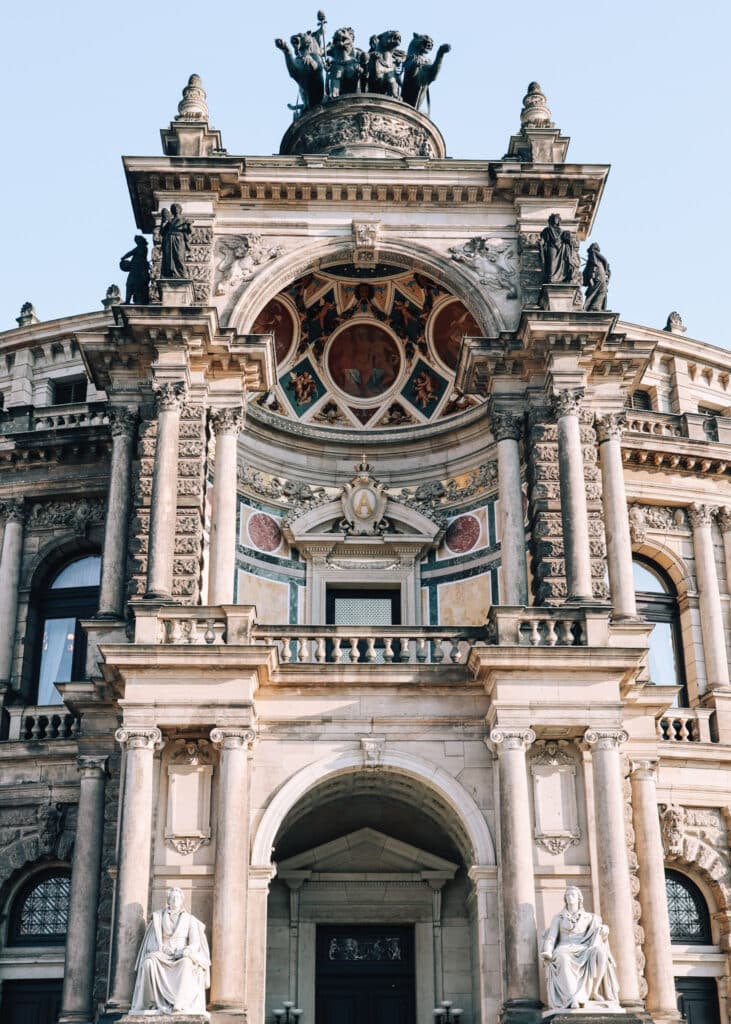
3. Classic vibes at the Semperoper
The Saxon State Opera House is a jewel of a building. I mean, just look at these details!
It is located just next to the Zwinger Palace, guarded by the statue of Saxon king Johann sitting on a horse. The first Semperoper was built in 1841 but was devastated by a fire less than 30 years later. The new one, which you can see today, was completed in 1878. Well, at least you can see the reconstruction of the 1878 version that was finished in 1985. Because, unlike the Fürstenzug, the Semperoper was greatly damaged at the end of the Second World War.
You can book a guided tour of the opera house to learn more about this stunning building and see the inside.

4. River bliss by the Elbe
Like in Berlin, Hamburg, and Prague, the Elbe flows through Dresden, splitting the city in half. On the left side is the old town, and on the right is the new town (which isn’t really that new anymore). Several bridges connect the two sides of the river, but like us, you will probably spend most of your time on the left side.
On the left riverbank, between the bridges Augustusbrücke and Carolabrücke, you find the Brühlsche Terrasse (Brühl’s Terrace). It was built on remnants from the city’s early fortification and is home to several monumental buildings, many of which are dedicated to art today. There are also places to sit down for a drink or a meal.
If you want to see more of the Elbe, hop on a sightseeing cruise or the hop-on/hop-off bus. We did the latter and compared to hop-on/hop-off busses in other cities, the route is quite long. It takes 1,5 – 2 hours in total, and you’ll see most of Dresden’s main sights and surroundings. Including the modern bridge that caused Dresden to lose its UNESCO World Heritage status.
Continue reading to see one of the most interesting places to get off the bus!
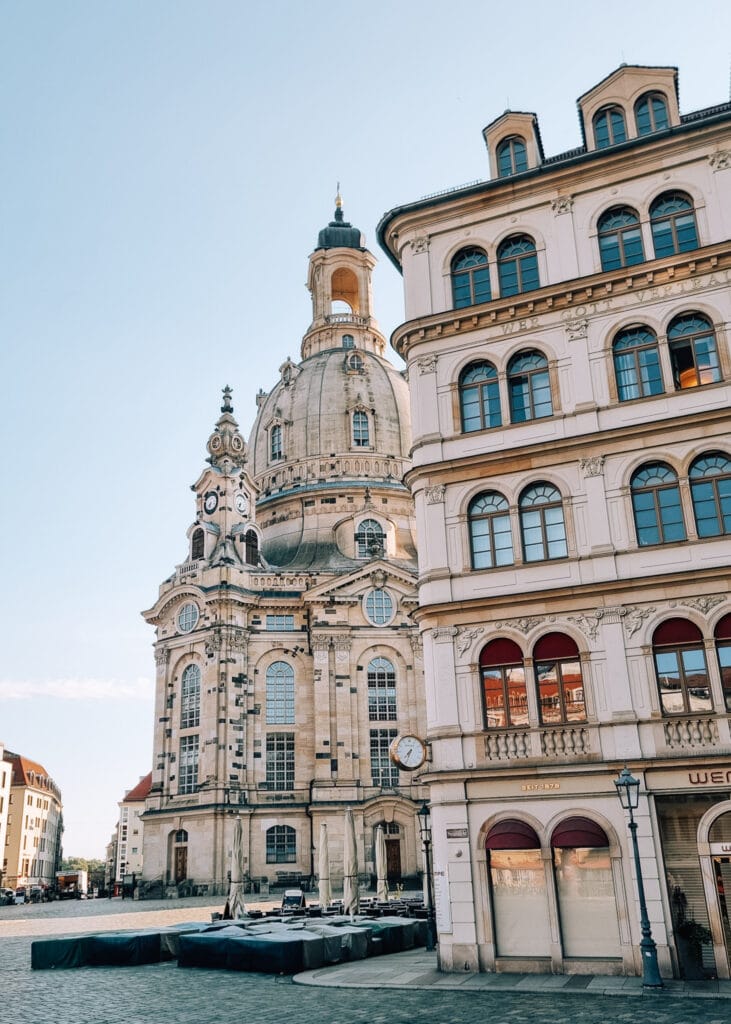
5. Frauenkirche – war memorial or church?
The Frauenkirche is located on the square Neumarkt and is perhaps Dresden’s most famous church. It was heavily destroyed in the firebombing in 1945 but reconstructed between 1994 – 2004. Why so late?
Because the East German leaders decided its ruins were to stand as a war memorial after the end of the Second World War. After the reunification of East and West Germany, this decision was changed, and they started the massive work on rebuilding it.
The Frauenkirche, or the Church of Our Lady, is a massive structure and at least as impressive on the inside as outside. You enter it on one side and leave it on the other. Due to a service taking place at the time of our visit, we didn’t spend much time inside nor take any photos.
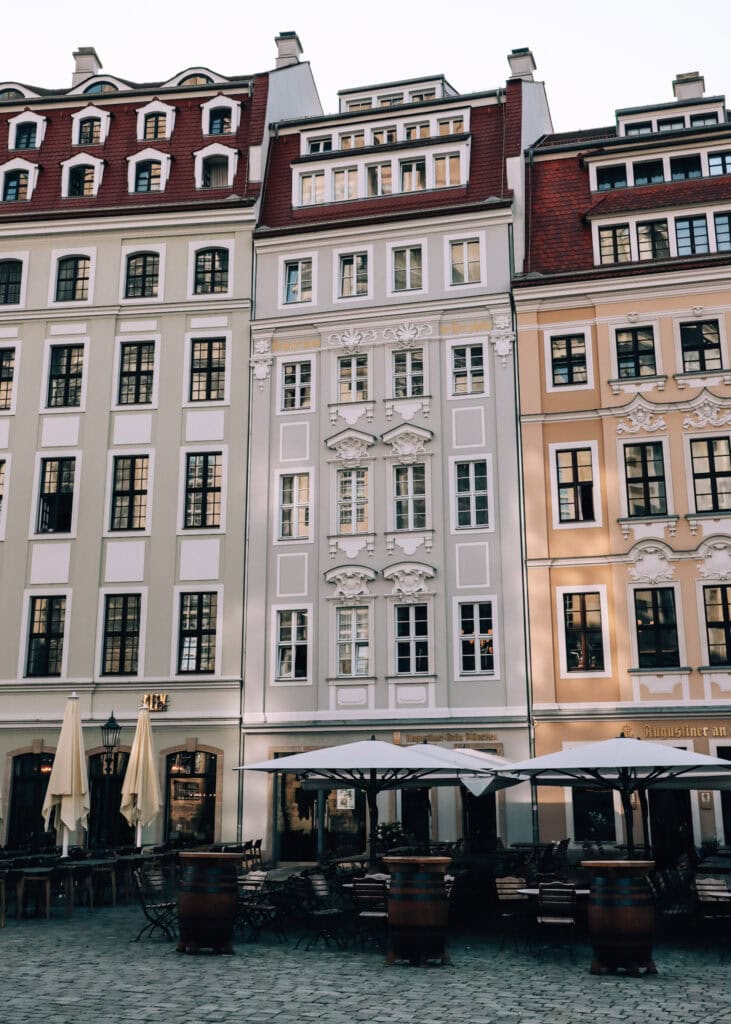
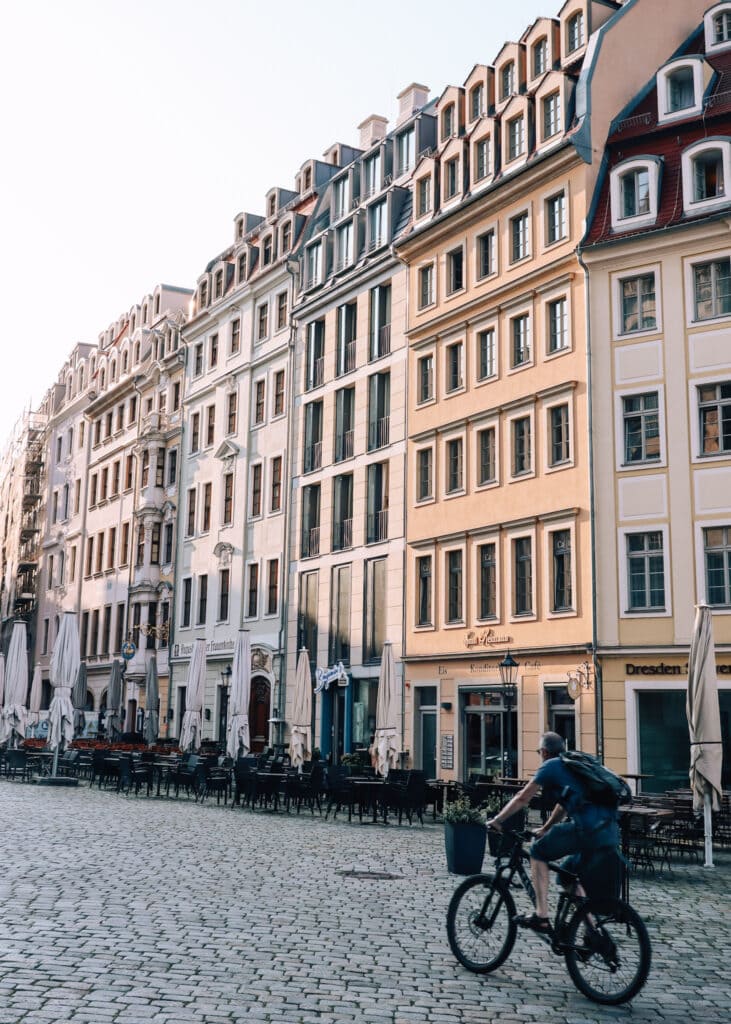
Neumarkt, the town square surrounding the church, is well worth a visit on its own. It’s packed with bars and restaurants, perfect for people-watching. There was even a summer festival going on when we were there in July.
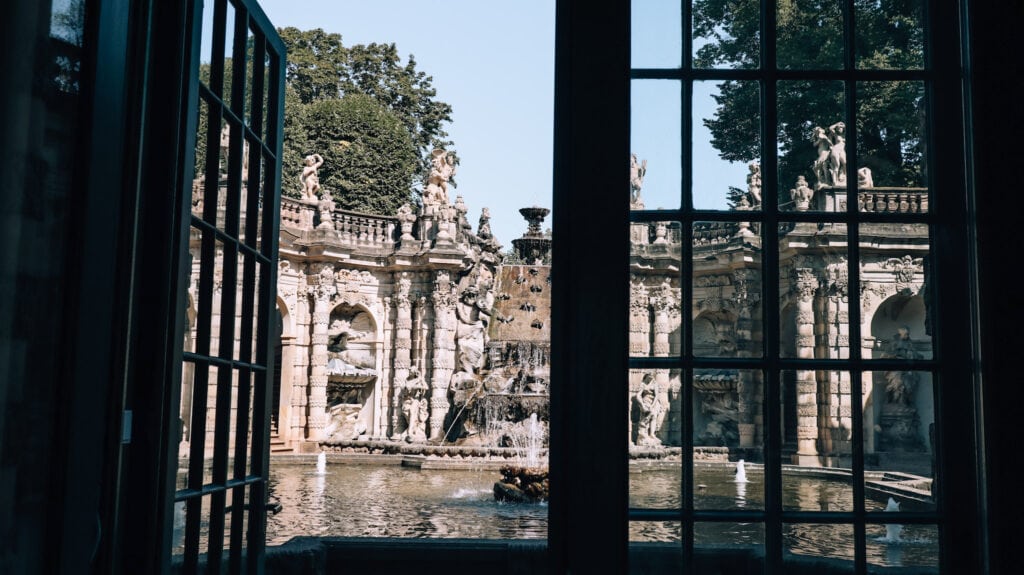
6. Inside the Zwinger Palace
The Zwinger Palace is just too pretty not to come back to. Although it was initially built as a venue for courtyard games and such, its interior is worth a visit. Since its post-war reconstruction, most of the interior was turned into museums open to the public.
You can find an art gallery dedicated to old masters, the Dresden Porcelain Collection, and the Royal Cabinet of Mathematical and Physical Instruments. Something for all tastes, I guess.
The courtyard was under full restoration at the time of our visit, and with only one day we didn’t want to spend it inside. However, it was still possible to have a look around at some of the interesting sights, for example, the Nymphenbad pictured above and the beautiful staircase in the Wallpavilion.

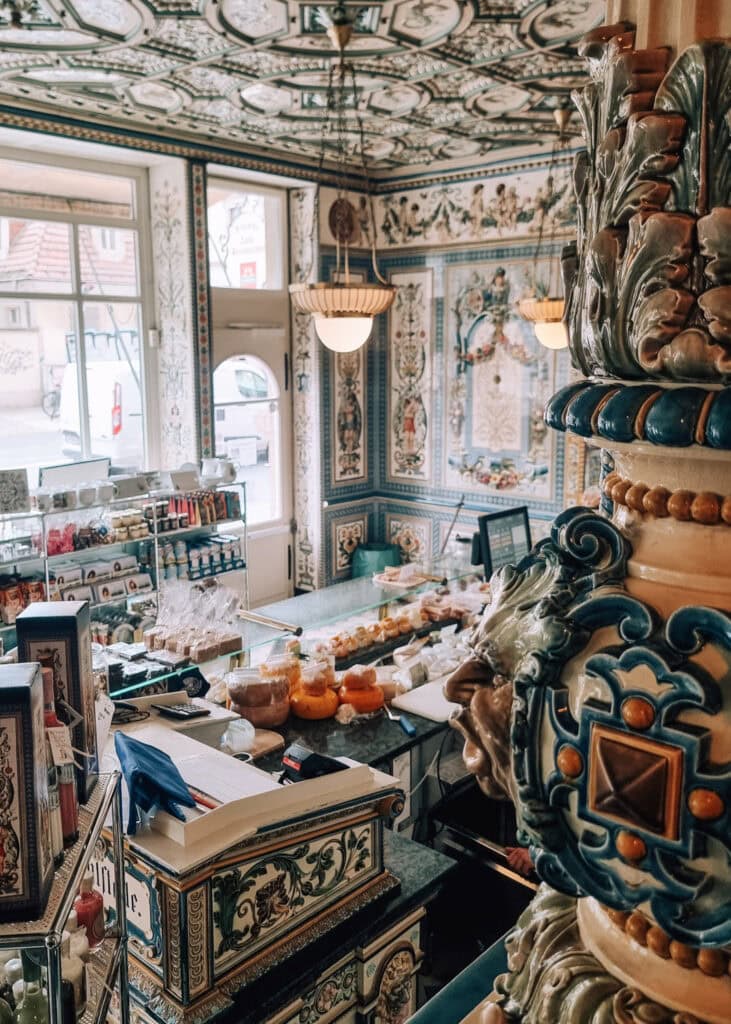
7. The world’s prettiest dairy shop
Have you ever seen a dairy shop as cute as this? I haven’t! And as soon as I read about it, I knew I had to pay a visit when in Dresden.
It’s located a bit out of the old town centre, and while it’s possible to walk there that was out of the question for us. Instead, we stopped here during our hop-on / hop-off bus trip.
The Dresdner Molkerei Gebrüder Pfund was opened in 1892 by the Pfund brothers. Being mostly famous for its 150 sqm of hand-painted tiles from Villeroy & Boch, the dairy shop still sells dairy products today.
The only minus was the lack of seating inside. So instead of purchasing anything in the shop, we headed upstairs to their café. Here, you find a large menu and a wide variety of mouth-watering cakes. But do not expect the same pretty interior as the shop.

8. Go treasure hunting
Just a stone’s throw away from the Zwinger palace, you find Dresden Castle with the eye-catching Hausmannsturm tower. Dating back to 1400, the 100,27-meter tall tower is the oldest part of the castle that is still standing.
As with so many of Dresden’s historic buildings, the castle and the tower were destroyed in 1945. The DDR didn’t start the restorations until the 1980s, but in 1991, after the reunification of East and West, the 30-metre was added, and the tower was back to its 1775 glory.
The bridge you see in the photo above is not Dresden’s answer to Venice’s Bridge of Sighs, but a direct passage from the castle to Dresden Cathedral.
Another interesting place to visit within the castle is the Green Vault. A museum holding the world’s largest collection of treasures!
The museum was founded as early as 1723, making it older than the British Museum!

9. Oriental vibes and a true hidden gem
A short walk away from the old town, you find a building very different from all others in Dresden. The Yenidze building looks like something that belongs much further east than Germany!
In reality, it’s a former tobacco and cigarette factory, built between 1907 – 09 in Moorish design. It’s a stunning building both from afar and up close and has no less than 600 windows of various styles. Today it’s an office building, a cultural venue and a restaurant.
As I love to check out fascinating architecture, I went there on my second morning in Dresden. The big surprise, however, came before I reached the old factory. I was walking along a railway bridge when I suddenly noticed beautiful murals in the bridge arches. I counted up to 20 different paintings, most related to train travel, and spent the rest of the morning studying them. The paintings reminded me of Hanoi’s beautiful mural street!
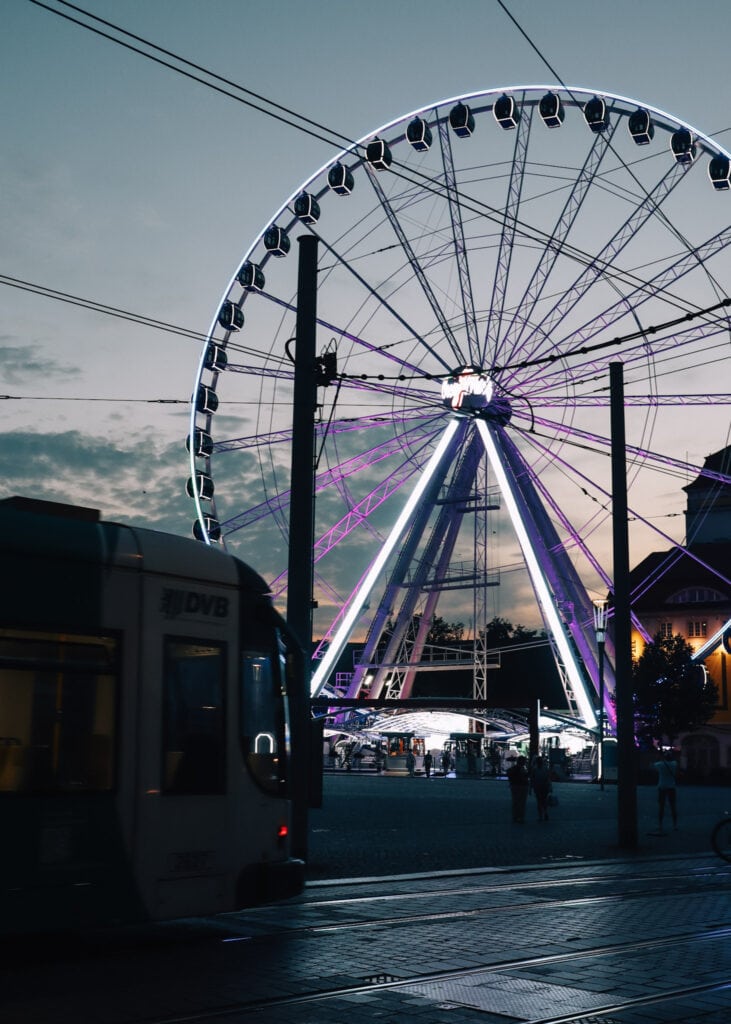
10. A modern city
If you read more travel articles about visiting Dresden, you will see that they, like me, mainly focus on the historic buildings of the old town. I think it’s still important to mention that Dresden is a large, modern city with all the amenities you will need. If you want to mix up all the sightseeing with some shopping, you’ll be happy to know that you find several shopping centres only steps away from the historic streets.
One peculiar thing my boyfriend, who’s not much of a city person, noticed, was how quiet the city was despite bustling with life and people enjoying the hot summer evenings.
We didn’t use any public transportation during our days there, but it seemed solid with an extensive network. That said, I recommend you stay within walking distance of the old town.

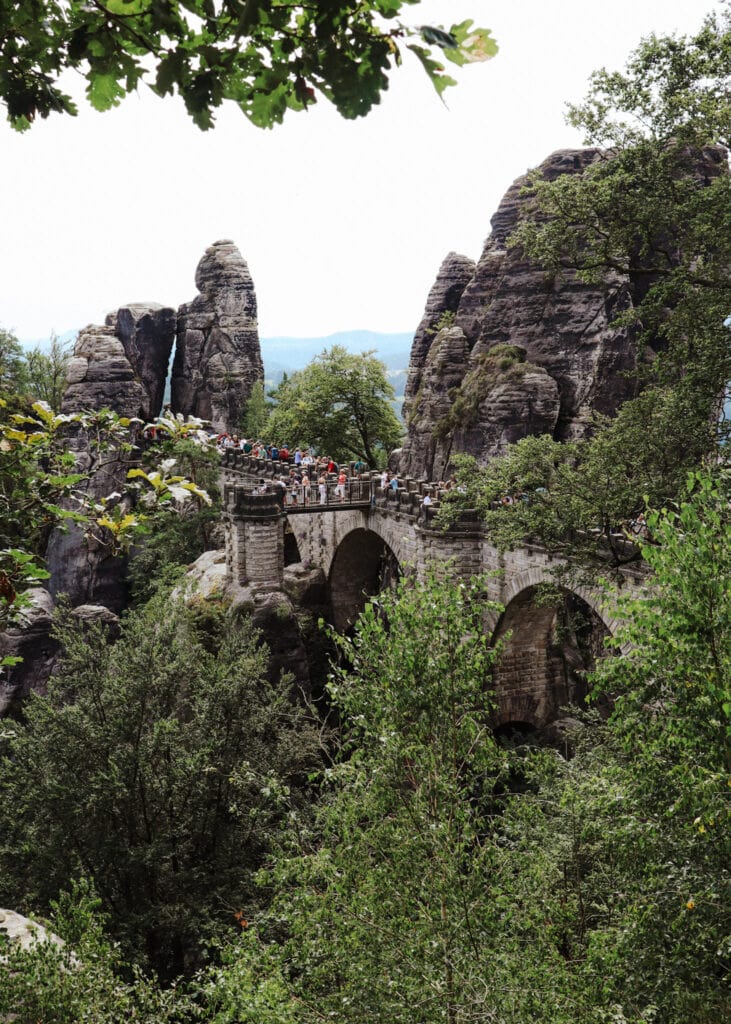
Bonus! Explore Saxon beyond Dresden
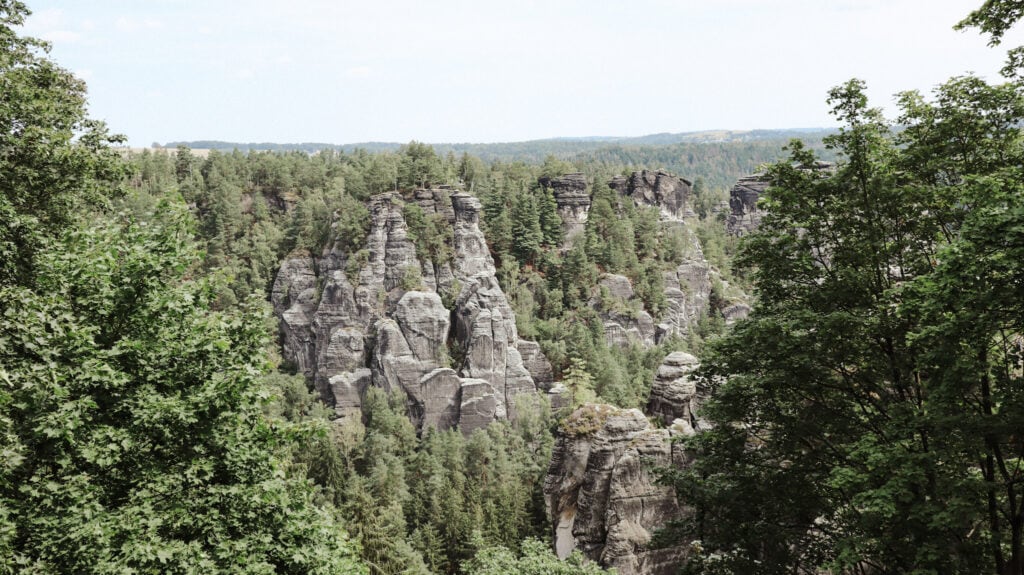
If you have the time on your visit to Dresden, I recommend getting out of the city and seeing a bit of Saxon. Approx. 45 minutes drive from Dresden, you find Saxon Switzerland National Prak and its famous Bastei Bridge. And believe me, you will be amazed – even though it can get a bit crowded.
As mentioned above, the landscape around Dresden is just undulating grain fields as far as the eye can see. But suddenly a huge, foresty gorge with 1100 sandstone rock pinnacles turns up out of nowhere.
Are you planning a road trip to central Europe?
Find more inspiration here.
Saxon Switzerland National Park was completely new to me until we randomly stopped by on our road trip this summer. Searching for places to see on our drive between Dresden in Germany and Wroclaw in Poland, Bastei Bridge popped up. And as I’m always in for a mix of history and nature, taking the small detour was a no-brainer.
Once there, we realised that the area is way more than an old bridge. Saxon Switzerland (Sachsische Schweiz) offers no less than 400 km of signposted trails and 12.000(!) rock climbing routes.
The National Park is located on the border with the Czech Republic and is not far from Poland either.
Ready to visit Dresden yet?
I hope these pictures (I know, it was more than 10) have made you put Dresden on your travel list. I surely want to go back, preferably in spring or autumn when the weather is a bit more sightseeing-friendly.
Or perhaps in December for a proper Christmas market atmosphere?
If you do decide to visit in the summer, make sure you book accommodation with AC. Trust me, it can get really warm here! I highly recommend booking through Pineapple Apartments, either on Airbnb, Booking.com or directly on their website. This is not an ad, I was just super happy with the apartment, the location and the communication with the company.


