Travelling to Vietnam soon? Before you go, here are 15 essential travel tips based on my own adventures, covering everything from navigating visa applications to staying safe with street food and choosing the best transportation.
Whether you’re craving bustling cities, dramatic landscapes, or hidden gems off the beaten path, knowing a few smart hacks and local customs can save you time, money, and headaches. Below you’ll find practical advice, apps, and things locals wish visitors knew. Everything packed into one survival guide.
Planning your first trip to Vietnam can feel both exciting and overwhelming. With buzzing cities, breathtaking landscapes, and a culture that feels worlds apart from home, there’s a lot to take in. To help you avoid surprises and make the most out of your time, I’ve put together these essential Vietnam travel tips.
Think of it as your quick survival guide, from what apps you need to street crossings and food safety, so you can focus on enjoying the adventure. All travel tips are based on my own experience from my visits to Vietnam the last couple of years.
I planned my Vietnam adventure three times and visited twice. The first time I didn’t get any further than Hanoi due to an acute kidney infection but spending a week in hospital abroad surely gives you some valuable lessons. It’s safe to say that I’ve spent my fair share of time reading blog posts, watching social media and Youtube content and scrolling through all sorts of online travel forums on Vietnam.
And from all that research, I gathered a lot of key information and tips that made my trip(s) a lot easier. Continue reading to find the travel tips I think you should know before visiting Vietnam for the first time.
1. Apps you’ll actually use
Grab: Asia’s answer to Uber and a must to get around. Book cheap and safe rides by car or motorbike. If you don’t feel like going out, Grab is great for ordering food as well.
WhatsApp: This might be an app you use daily at home, but if you don’t: make sure to download it as soon as you start planning your trip. This is where you communicate with guides, accommodations, drivers and fellow travellers.
Google Translate: While English is spoken by many Vietnamese, you will still most likely come across situations where you need easy access to translation. By using the app’s camera function, you get a written translation of text in seconds.
2. Cash is King
Vietnamese Dong (VND) is the local currency. It can be a bit confusing at first with the high numbers (1 Euro is approx. 40.000 VND), so my best advice is to have a currency converter at hand (on iPhones you can use the calculator app) and to learn what 100.000 VND is in your currency.
Most shops, restaurants, taxis, guides and markets prefer cash. Try to have some small notes available. Some larger restaurants, shops and most hotels take credit card. They usually add a 3-4% transaction fee when paying by card, but so do ATMs. ATMs are frequent in any larger city and it’s easy to find them using Google Maps.
3. Do you need a visa?
This one is key. As a Norwegian, I’m lucky to get 45 days visa exemption in Vietnam, but most travellers need an e-visa. Apply online at least a week before your trip and keep both a digital and printed copy. You will likely be asked to see it before boarding your flight to Vietnam.
If, by any chance, you have issues with the eVisa application, you can use local Vietnamese Visa agents. They can get you a visa within a day. I can vouch for Joey Visawhich I used for another service.
4. Trains, buses or flights?
You’re probably visiting more than one destination on your Vietnam trip. So, what is the best way to travel between them?
Bus
Vietnam is famous for its cheap sleeper buses where seats are swopped with beds. I never took one, but as long as you are not very tall, they seem comfortable and stop every few hours for a toilet break. From what I’ve read, the drivers can be a bit hazardous, and it’s recommended to go during the day rather than overnight for safety reasons.
Limousine bus
This I took several times, and the limousine buses are basically smaller buses or vans with large, comfy seats. Often, they bring you from door to door too. Would 10/10 choose this transport method again for journeys up to 4-6 hours.
Trains
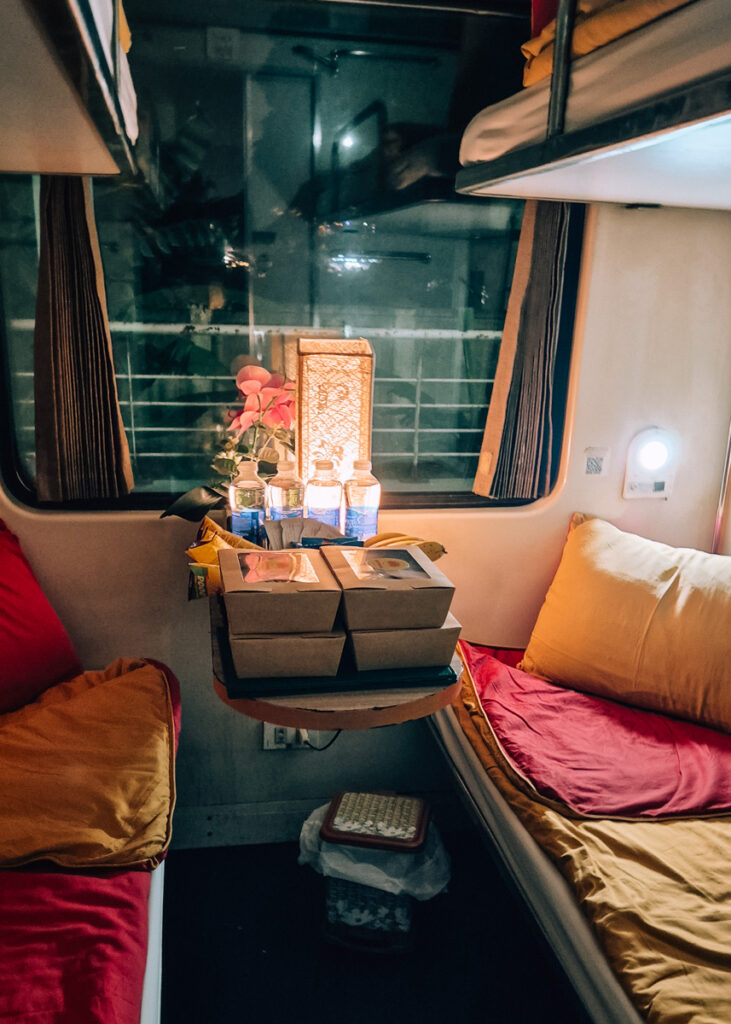
Trains are an adventure but slow. Overnight train is a great option if you want to save a night’s accommodation while getting from A to B. I took the the night train from Ninh Binh to Phong Nha and slept surprisingly well. Make sure to choose a soft seat, which is not very soft but a bed. I recommend booking with Lotus Train, which cost a bit more but have clean facilities and give you a free drink in the evening and breakfast.
Flying is by far the most efficient way to get around and often cheaper than the train. I travelled with Vietnam Airlines from Da Nang to Ho Chi Minh City and they even got me on an earlier flight than the one I booked.
Private and shared cars
This is an option for shorter transfers such as from Hue to Da Nang / Hoi An. If you are more than 2 people booking a private car with driver can be just as reasonable as any other option. Since I travelled solo, I opted for a shared car from Hue and although it had to make two stops in Da Nang enroute Hoi An, it dropped me off at my hotel way faster than I’d get there by bus.
Use the 12Go-website to find the best transport options for your journey and book either there or through your accommodation.
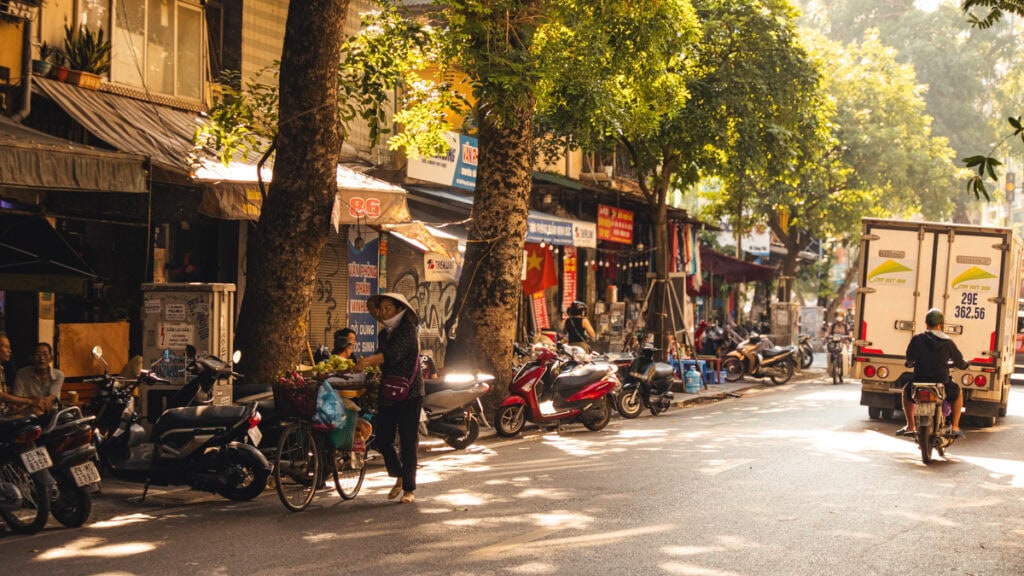
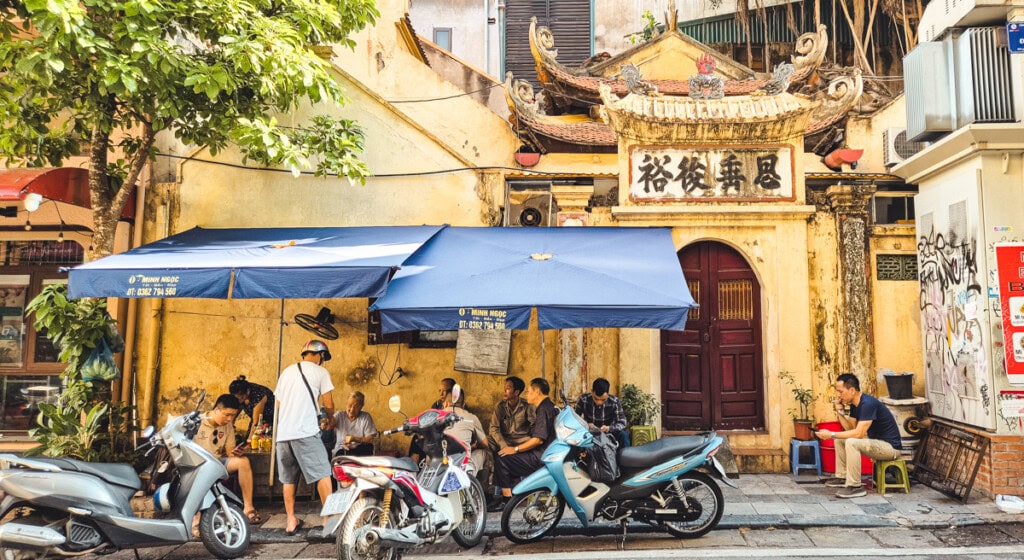
Early mornings in Hanoi are not as busy as later in the day.
5. How to cross the street
Traffic in Vietnam really is something else and the most important skill to learn is how to cross the street. It sure feels daunting standing by an endless stream of vehicles trying to get to the other side.
What you do is look for a break in bigger vehicles (cars and buses), focus on a point on the other side of the street and walk slowly towards it. Traffic looks chaotic, but there’s a rhythm to it and scooters and motorbikes will move around you. If a car comes, simply walk slower and stop till it’s passed. And whatever you do, do not speed up or run!
Since January 2025, the police have become stricter in issuing fines to drivers running red lights, and there was a significant change from my first visit to Hanoi in 2024 when no one seemed to care about red or green lights.
6. Learn a little language
This is a good tip wherever you plan to travel. You don’t have to be fluent, but even just saying hello and thank you in the local language will bring smiles. A few words show respect and effort. Vietnamese is a tonal language, which means that words can have the same base letters but mean completely different things based on what diacritics are added to the letters.
Hello – Xin Chao (or just chao)
Thank you – Cam on
Good morning – Chao buoi sang
Good night – Chuc ngu ngon
Excuse me – Xin loi
Don’t worry if you pronounce it wrong, the locals will be quick to correct you. Asking for how something is pronounced is also a good way to start a conversation!
Vietnam stretches 1,600 km, so climates vary. In fact, there are 3 distinct climate zones. The north has four seasons, much like Europe where winters can get quite cold and summer is humid and hot. The central and southern regions have wet and dry seasons, but at different times.
In general, March–April and October–November offers the most comfortable weather throughout the whole country. Although October and November can we quite wet in central areas and floods in Hoi An is not rare at this time of year.
XO-tours take pictures and send them to you after you leave.
8. Join a guided tour
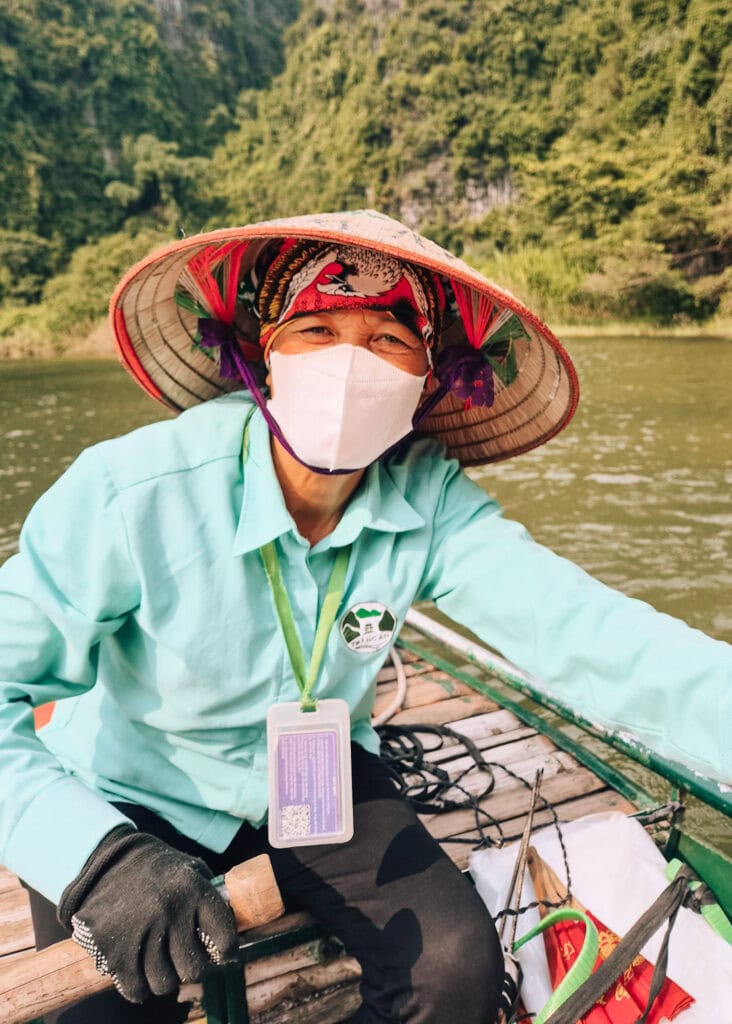
And do it as soon as possible. A good guide can open doors to authentic food stalls, hidden alleys, or deeper history you’d miss on your own. Plus, they will teach you how to cross the road! All the guided tours I’ve been on in Vietnam have given me great insights into everything from history and culture to food and what modern life is like.
Booking a food tour on your first evening may even help beat jetlag, as you can’t just go to bed early.
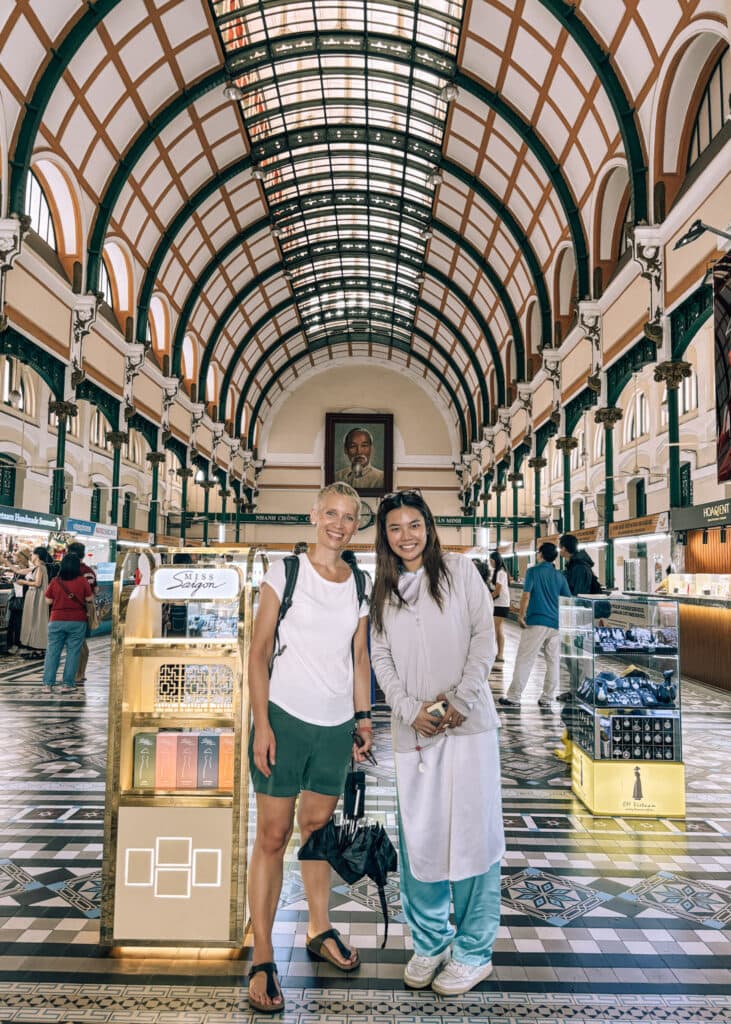
If you arrive in Ho Chi Minh City, do yourself a favour and book a city tour or food tour with XO Tours. Their tours cost a bit, but they are so well laid up and professional.
You find free guided tours in all larger destinations, and while they are usually good and the guides nice, I’ve liked the other tours more. A free tour isn’t free by the way. They are tip based, and the guides here are expected to get the same amount as you would tip a free guide in i.e. Rome.
For those of us not coming from a place with a strong tipping culture, this one is always a bit tricky. Perhaps it’s the same for you who are used to it at home?
Vietnam doesn’t have a tradition for tipping, but with growing tourism numbers it’s becoming more relevant. Many guides and drivers expect it, and I think it’s reasonable to give them something as a way to say thanks.
So, how much is something? It depends on the service they’ve given. Give more for a full-day tour than a short drive. At restaurants, add 10% and round up the fare on Grab-rides. Some hotels have tip boxes where they split the total on all staff.
Even though it’s tempting to give a high tip to someone you’ve connected well with, you shouldn’t give too much. When enough people do this, we can end up with employers not paying reasonable salaries and rely on tip instead.
Bring a wrap-around skirt to put over your shorts when needed!
10. Respect local customs
Although you can wear almost whatever you want around Vietnam, remember that tradition and culture are important to the Vietnamese.
Both men and women should cover knees and shoulders and remove hats on religious sites and formal places. Some places there are guards that stop you, but even if there isn’t it doesn’t mean you should just do as you feel like.
Removing shoes before entering a home is another important Vietnam travel tip. This also relates to some homestays. As much as they can resemble a hotel, they are still homes.
Also make sure you do not point with your finger. Use your whole hand instead.
Hue Sweethouse 2 HomestayHue Sweethouse 2 HomestayTam Coc Village BungalowsTwo of the beautiful homestay’s I stayed at.
11. Homestay or hotel?
Scrolling through Booking or other accommodation apps for any location in Vietnam, it can be hard to tell which are homestays and which are hotels.
When I first heard of homestays, I thought of just a room with shared facilities in someone’s house. A bit like renting a room on AirBnB. This can be the case in Vietnam too, but in my experience, it’s mostly hotel standard accommodation run by a family who also live on the premises.
Compared to a hotel, many homestays are more like boutique hotels and boutique hotels with fewer rooms and a more intimate vibe. Perfect for solo travellers!
Just bear in mind that the level of English can vary, but usually at least one in the family can communicate well.
My recommendation? Mix it up. Stay in homestays some places and hotels in others. Just make sure to do proper research before you book. And that brings us to the next travel tip.
Did you know that Vietnam is among the top 3 on the list of countries with the most fake travel related reviews? It didn’t surprise me after all I’ve heard and read throughout my research.
I’ve heard of restaurants offering discounts to guests giving them a full score review before paying, guides that have literally chased guests who didn’t want to leave a review, and hotel receptionists grabbing guests’ phones to make a review.
That said, on my last visit, I didn’t encounter any of this. Nothing else than a simple question to leave a review if I was happy.
So, how do you check if a review score is true? Check this:
Read the worst reviews. Are they something you can live with, go for it.
Are there many review scores without any text? Something is off.
Do many reviews have the same wording? It may have been a copy/paste job.
Don’t trust just one channel. Read reviews on Booking.com and Google, Get Your Guide and Tripadvisor.
Guided tours are great for food tasting in safe environments.
13. Food & water safety
Food poisoning can happen everywhere, but the risk is a bit higher when you travel across the world to a different climate than what you’re used to. Food in Vietnam is a feast for your taste buds, and you shouldn’t be afraid to try. Try sticking to food that is cooked, boiled or peeled, and choose busy street food stalls and restaurants. Places that are busy with locals are recommended over touristy ones.
Do not drink tap water in Vietnam. The locals don’t do it either. Buy bottled water and bring a refillable bottle to use refill stations where possible. To be on the safe side, use this for brushing your teeth too.
What about ice cubes? I must admit I was a bit sceptical to ice cubes at first but gave in pretty soon. It’s just super hard to avoid iced drinks, because have you seen the iced coffees and juices in Vietnam?! On a general basis, ice cubes come from a fabric and are made of purified water. Look for cylindrical shaped cubes with a hole in one end, and be sceptical to chipped ice and ice from very small vendors.
14. Watch out for common scams
There are significant economic differences between many of the locals and the tourists visiting Vietnam. Because of this, it’s not surprising that some try what they can to earn a little extra. Still, it never feels good to be taken advantage of. And it can be useful to know about some of the most common scams before you arrive.
Overpriced taxis and driver’s giving you back the wrong change is a classic. Avoid this by using the Grap app instead. And take the time to learn how the how the different VND notes look like. Getting the wrong change back can happen in other situations as well.
In the larger cities, you can be approached by very insistent shoe shiners. If you don’t want your shoes done, do not hesitate for a second, just say “no thanks” and move on. If you hesitate, you may find yourself on a stool wearing borrowed sandals in no time. You’ll get your shoes back nice and shiny, but it will cost.
Fruit sellers on the street may also approach you and ask if you want to hold their shoulder pole. If you want a picture of yourself carrying it, go for it. Just don’t believe it’s for free.
This is how happy cycling around Ninh Binh make you!
15. How to get around
The central areas of larger cities like Hanoi, Hue and Ho Chi Minh City are quite walkable, just be aware of your surroundings and traffic as you’ll be in and out of the street. The sidewalks are for motorbike parking, restaurants, markets and everything else than walking.
For longer distances within the cities, use Grab for what it’s worth. Scroll up to my Vietnam travel tip #1 for more info. Hop on – hop off busses can also be a good idea if you’re short on time.
In the more rural places, go bicycling! Cycling is 100% the best way to get around destinations such as Ninh Binh and Hoi An. You experience so much along the way and the scenery is gorgeous.
What about motorbikes? That’s definitely an option as well. Just check what your travel insurance covers, as Vietnam allows very few international driver’s licenses. Instead of driving yourself and risk getting fined or insurance issues, I recommend hiring an easy rider. This means you have a local, professional driving, and you can just enjoy the views.
Conclusion of my best Vietnam travel tips
Vietnam is one of those places that stays with you long after you’ve left. Not just for the sights, but for the people, food, and energy that make every day an adventure. With a little preparation and the right mindset, your first visit will be smoother, easier, and even more rewarding. Take these tips as a starting point, add a dash of curiosity, and you’ll be ready to dive in headfirst.
And you? If you haven’t already, buy travel insurance. Never ever travel anywhere without. No one plans to get sick or hurt, but it happens. And if it does, I bet you’ll be as happy as I was to get the best care possible in the country you are. Especially if you’re far away from home, in a place you don’t speak the language.
Anne
I’m Anne, a Norwegian travel writer and photographer with a background in tourism and social anthropology, with a long-standing love for UNESCO World Heritage Sites.
When I’m not working my full-time job in the tourism industry, I’m usually planning my next journey focused on culture, nature and meaningful travel experiences.
Through Heritage Wanderlust, I share practical itineraries, honest travel tips and personal stories for travellers who want to make the most of limited vacation time without rushing through the world.
Guide to 9 of the most frequently asked questions about visiting Halong Bay, from choosing between Halong and Lan Ha Bay to deciding how long to stay, the best time to visit, and how to pick the perfect cruise for you.
When I got ill and hospitalised on my dream trip to Vietnam, I just had to make the best of it. Read on to find my 13 best tips to get the essence of Hanoi without visiting the major attractions.
The street vendors in Hanoi are an iconic sight. Almost as much as the Insta-famous train street. But who are they? And where do they come from? Scroll through my photo story to learn more.
It’s not without reason that Vietnam’s coffee culture has become famous. Learn all you need to know and how to explore it in Hanoi.
3 Comments
I leave for Hanoi tomorrow and have been nervous, this being my first time visiting Vietnam. Your blog has really helped me feel more prepared and at ease! Thank you ?










I leave for Hanoi tomorrow and have been nervous, this being my first time visiting Vietnam. Your blog has really helped me feel more prepared and at ease! Thank you ?
I’m so glad to hear that! Vietnam is wonderful and I hope you have a great trip.
Good heritage and culture