


How to visit UNESCO-listed Urnes Stave Church
Do we have to back the car on board? I shout out our van’s window. Yup, was the ferry man’s short and concise answer. We were standing on the small ferry quay in Solvorn, ready to board the equally small ferry to visit Urnes Stave Church. And I was glad I wasn’t the one in the driver’s seat. On the other side, everyone should practise their backing skills before setting out on a road trip in Western Norway. It will come handy!
Why visit Urnes Stave Church in Norway?
If you are planning a trip to Norway, chances are you have already read something about the stave churches. They are an important part of the Norwegian cultural heritage, and in medieval times there were more than a 1000 of these churches spread around the country. 28 of them are still standing today.

Urnes is the oldest of the remaining stave churches. Because of that it was enlisted as a UNESCO World Heritage Site in 1979. The church was built in the 1130’s, but parts of the impressive décor are even older and belonged to the previous church that stood on the same place. Actually, the church from 1130 is the 4th in line on that exact spot.
Also, don’t believe you only visit Urnes Stave Church for the historic architecture though. As you can see on the images, the location, towering on a hill above the emerald coloured Lustrafjord in the quaint settlement of Ørnes is almost unmatched when talking about natural beauty as well.
How to visit Urnes Stave Church
First, you have to get yourself to Solvorn. An extremely idyllic fjord village nestled between the fjord and the steep mountains. Just under 20 kilometres from Sogndal, the nearest larger town. You can either come on a day trip, or, like I definitely will do next time, stay overnight. Norway’s oldest hotel, Walaker Hotel, is on my bucket list, but there are other more budget-friendly alternatives such as Eplet hostel as well.
From Solvorn, you catch the petite car ferry across the fjord to Ornes. In 2026, the ferry price for a car >6 metres with driver it’s NOK 210, and an adult without a car is NOK 75. All prices are one way. The ferry operates from the beginning of May until the end of September. Click here to see the schedule and price list.
If you decide not to bring a car, mind that you need to walk a kilometre uphill from the quay to the church.
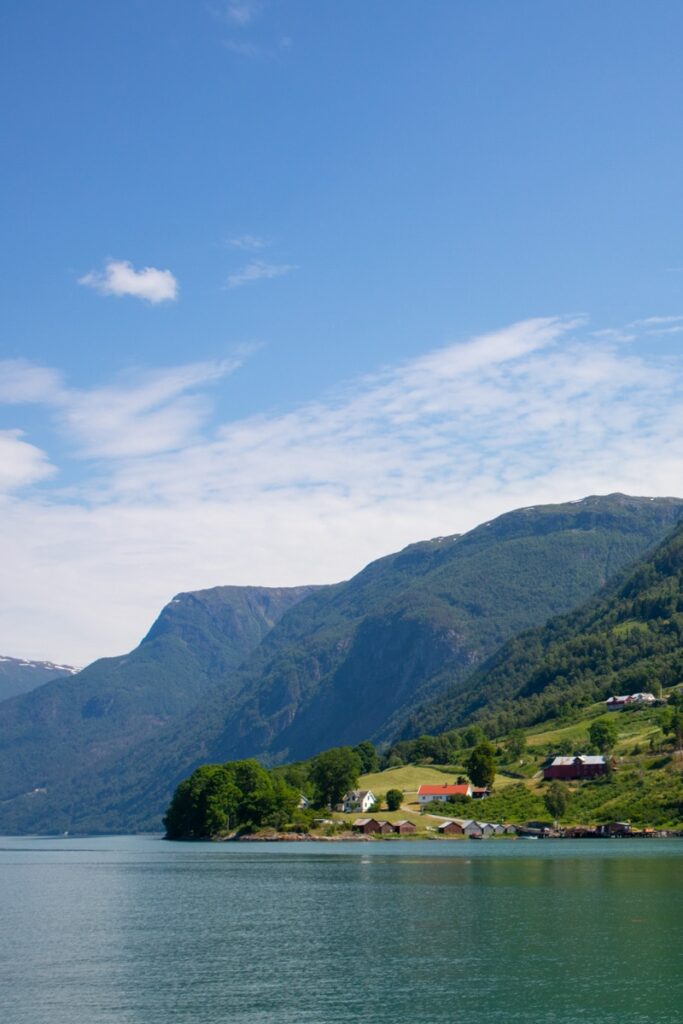

The fjord crossing takes approx. 15 minutes’ and is a stunning ride with panoramic views. Once at Ornes, it’s easy to follow the signs to both parking lots and the church itself. There are only a few places to park next to the church, and it’s recommended to park at one of the larger lots closer to the fjord.
Tickets and guided tours at Urnes
Arriving at the church, you first see a small café in an old barn. This is a good place to get some refreshments after the climb up the steep hillside. Next door, you find the hut functioning as a ticket office and information centre. In 2026, tickets costs NOK 150 for adults and children/students NOK 100. Just as the ferry, the church is open for visitors between May and September. See updated opening hours and prices here.
If you want to enter the church (which you should!), you need to join the included guided tour. Tours are approx. every 15-20 minutes.
Note! Drone flying is strictly forbidden. If you dare trying, all staff will drop whatever they are doing to come find you…
What is so special about stave churches?
That is an accurate question to ask. One could believe it’s about the age, but you’ll find plenty of stone churches built around the same time – also in Norway.
Stave churches are so special because they are made of wood. The only element of the remaining 28 churches that are made by stone, is the foundation the wood stands on. One of the reasons many of these churches have disappeared, is lack of foundation. What happens to wood put directly on the soil? Especially in climates such as in Norway? The wood rots…
Which is also the reason today’s church is the fourth on Urnes, even though it was built only 110 years after the country officially was Christened.

Another highly visible element is the decorations. What other churches are decorated with dragons, sea monsters and snakes? These decorations are remnants from Norse mythology and even though the Norwegians had been Christian for many generations at the time, it is safe to believe they still clinged on to some myths. Especially in rural areas where most of the stave churches are found.
How were the stave churches built?
Professional, travelling groups of carpenters are constructed the stave churches. It is a well-known fact that the Vikings were globetrotters, but the Norwegians continued to travel abroad also after the Viking era. And most likely, craftsmen and architects found international inspiration for the churches.
Building the stave churches was a lengthy process. It started with most important part: the staves. Or three trunks, which is a more descriptive word. First, they found a number of large pine trees in the nearby woods. Then they cut of all branches and removed the birch, before they left it still standing on its roots.

Building with patience
Only about 5 years later, the three trunks were ready to be cut down. Now hard and solid enough to make out the vertical of the church, with interlocking joints at the corners. Horizontal beams and braces were added to strengthen the structure. Vertical planks make up the walls, while the steep roof with is covered with intricate wooden shingles. Elaborate carvings decorate the exteriors, depicting religious motives, Norse figures and intricate patterns.
The end result was a remarkable fusion of architectural craftsmanship, woodwork, and spiritual symbolism.
To preserve the wood safe from wind and weather, tar was used to cover the exterior. An organic black or brown material distilled from organic materials such as wood. Even today, tar is being used to preserve the churches, and as you can see on the pictures it is soon time for Urnes to get a new layer on its southern side.
Urnes: A stave church still in use
Throughout the history, the stave churches have been living and eveloping with the local communities. Urnes is still in use, at least during the summer half of the year. To meet the changing times and standards, it has, like many other of those still standing, it has been rebuilt several times. The exterior, however, stands as it was built.
The most important changes to the stave churches, and also Urnes, came after the reformation in 1537. When Norway went from being catholic to protestant. This led to benches being put up for people to sit on, an extension of the choir was made, and the altarpiece was put in.


A rich farmer’s request of making a VIP section for himself and his family almost ended the church’s history in the 18th century. In the making of his private section, they removed one of the staves… Luckily, they noticed the mistake and put up extra beams to keep the church standing.
Most of the décor have been gifted to the church throughout the years, but a few pieces are orginal from the 12th century. One that stands out, are the group of three figures hanging on the wall in front of the choir, depicting the Golgotha scene with a suffering Jesus on the cross and the grieving Mary and John on each side.
A church that is not in use anymore, but has been taken back to its pre-reformatory state, is Borgund Stave Church in Lærdal. Visit it during the summer season to see the the most authentic of all the stave churches.
Other things to do near Urnes
Once you are at Urnes Stave Church, I recommend you explore more of the pretty Lusterfjord area. The fjord itself is a jewel, with its characteristic emerald colour. To do so, you need a car – either your own or a rental. Bicycling is an option, but you need to have your wits about you on the narrow and, at times, busy roads.

Idyllic Solvorn, as mentioned earlier, is a good place to start. Not only is it here you catch the ferry across the fjord, but it is also near other attractions such as the hike to mt. Molden. I have yet to do this hike, but it is at the top of my list of peaks I want to climb – the view from the top looks absolutely phenomenal!
After visiting Urnes Stave Church, I recommend continuing on the road around the fjord. The road on the Urnes side of the fjord isn’t very busy but narrow many places. Hence, practice your backing skills and look far ahead while driving. Also, always check your rear mirror regularly. Do you have a car breathing your neck? Stop and let it pass you.
Remember, locals knows every turn and twist on the roads and just want to get from A to B without admiring the views.
Feigefossen waterfall
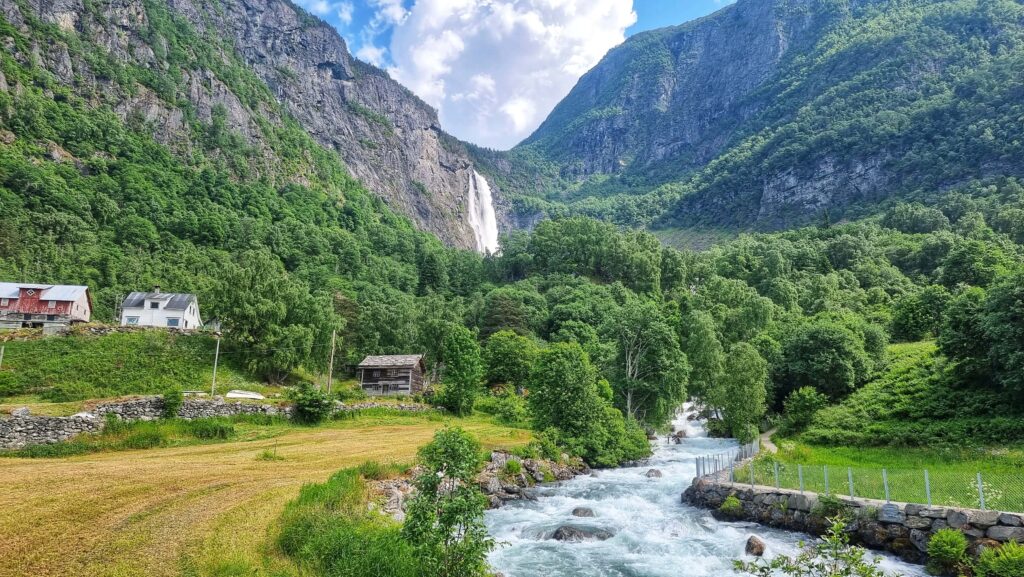
About half-way between Ornes and Skjolden, at the end of the fjord, you find the powerful Feigefossen waterfall. It’s 218 meters tall and one of the highest unregulated waterfalls in the country.
A few hundred metres past the falls, there’s a small parking lot and access to toilets. Walk back and admire Feigefossen from the road or put your hiking shoes on and follow the 1,6-kilometre-long signposted trail to a viewpoint near the fall. The hike takes approx. 1 hour and 30 minutes return trip.
Between the trail start and the parking lot, you should drop by the small café next to the road. It’s a local initiative and has a lovely terrace only metres from the glittering fjord.
Skjolden and Sognefjellet Scenic Route
The innermost village of the Lusterfjord, Skjolden, is the gateway to Sognefjellet. It is probably Scandinavia’s most spectacular mountain pass, and where you find some of the most impressive and tallest peaks in the country.


If you are on a road trip around Norway, Sognefjellet is a good place to go north-east to Lom and Gudbrandsdalen valley. On a day trip, you can stop at either Turtagrø Hotel or Sognefjellshytta for a bite and something to drink, instead of driving all the way across.
Do you prefer to stay by fjord level? Head over to Skjolden’s small beach and picnic area and relax for a bit.
Kayaking on the Lusterfjord
Do you like paddling? Or want to try? The you should definitely head out and explore the fjord from a kayak. We brought our own, but you can rent from several of the accommodations in the area or join guided tours.

Jostedalen and Nigardsbreen glacier
How about doing some glacier spotting while in the area? From the town Gaupne, take a detour up Jostedalen valley. After approx. 30 minutes’ driving, you’ll see Breheimsenteret glacier centre. Here you can learn more about glaciers and enjoy lunch in the restaurant, before getting closer to the glacier itself.
Nigardsbreen glacier is an arm of Jostedalsbreen glacier, the largest glacier in continental Europe.

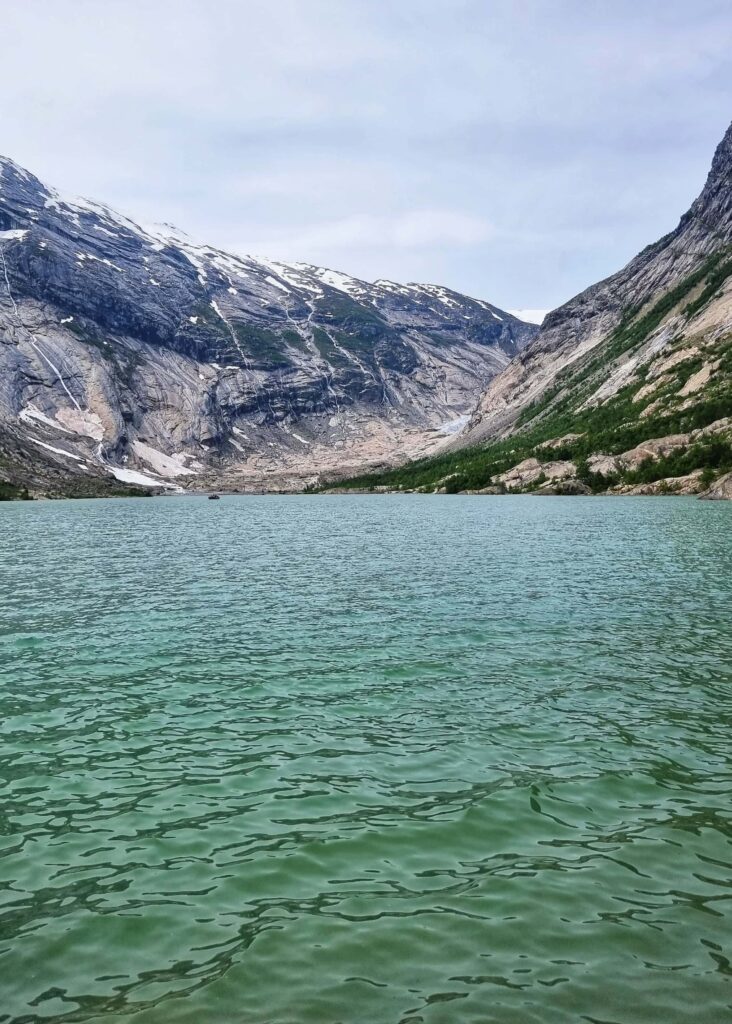

Follow the private road for 3 kilometres until you reach a large parking lot next to the glacial lake. Mind that it is a toll road and in 2023 the price for a normal vehicle is NOK 90. Here, you have several options. The quick one is to walk over to the end of the parking lot where you can spot the blue ice in the distance. The easy option to get closer to the glacier is to jump into one of the shuttle boats on the lake (NOK 75 per adult). And last, is the more challenging but also more rewarding option: walk for an hour to the nearest glacier viewpoint.
Like all glaciers, Nigardsbreen is reclining and while a few decades ago you could see it well from the parking, it is now recommended to get closer. Just bare in mind that the glacier is alive and can be dangerous, so follow signs and do not climb over fences etc. If you want to climb the glacier, book a guided tour!

Final notes on visiting Urnes Stave Church
As you hopefully have understood by now, a visit to Urnes Stave Church is not just a regular church visit. It’s the perfect mix of culture and nature in one of Norway’s most picturesque regions. I’m almost embarrassed it took me close to 38 years to come here. Did I mention Luster is only a 2,5 hours’ drive from Voss?
Better late than never, I guess.


